Signed, Sealed, and Worn: How Collectors Are Turning Shoes Into Personal Masterpieces
There's a moment that serious shoe collectors know well. You're at a dinner, a gallery opening, maybe just a really good Saturday brunch — and someone glances down at your feet and says, "I've never seen those before. Where are they from?" For most people, that question has a one-word answer: a brand name, a retailer, a season. But for a quietly growing group of collectors across the US, the answer is something far more personal: me.
Not in a DIY sense. Not a bedazzled sneaker from a craft night. We're talking about the real thing — bespoke and semi-custom footwear created through genuine collaboration between collector and maker, resulting in a shoe that carries a design fingerprint no one else in the world shares. It's a corner of the luxury shoe world that doesn't get nearly enough attention, and honestly? That's kind of the point.
Why "Off the Shelf" Starts to Feel Like a Ceiling
For collectors who've spent years — sometimes decades — building a footwear wardrobe, there comes a natural inflection point. You've done the heritage houses. You've tracked down the limited editions. You've learned to spot craftsmanship from across the room, and you've developed opinions about last shapes and heel heights that most people don't even know exist as opinions.
At that stage, buying another beautiful shoe from a beautiful brand still feels good, but it doesn't feel enough. Because no matter how rare the colorway or how exclusive the drop, someone else out there is wearing the same thing. And for a collector whose relationship with shoes is deeply personal — tied to identity, memory, and self-expression — that sameness starts to chafe.
Custom and bespoke shoemaking offers a way out of that ceiling. Instead of choosing from what exists, you get to decide what should exist.
What the Collaboration Actually Looks Like
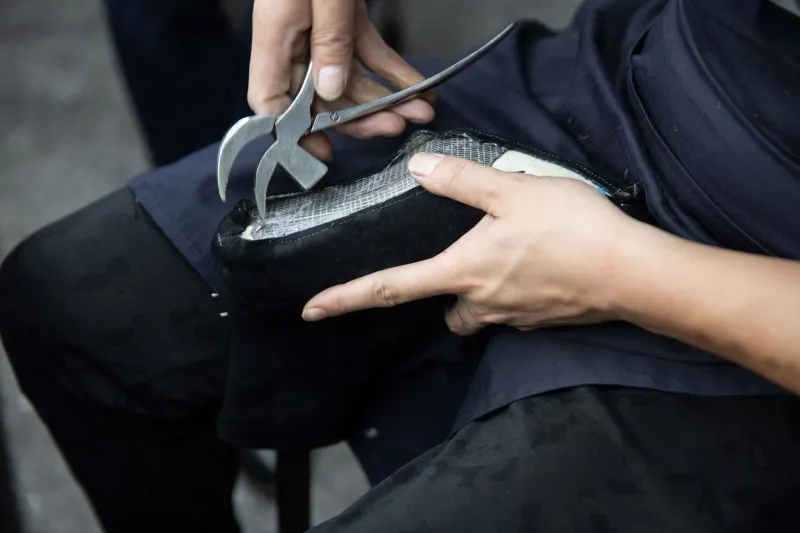
The process varies depending on the maker, but the general arc is surprisingly intimate. Most collaborations begin with a conversation — sometimes several — where the shoemaker or designer tries to understand not just aesthetic preferences but the collector's lifestyle, their existing wardrobe, even the way they move through the world.
A collector in Chicago, for example, might work with an independent cordwainer to develop a boot that pulls from the visual language of 1940s menswear while being built on a last specifically shaped to her foot. The leather might be sourced from a tannery she selected herself after seeing swatches. The lining might be a color only she and the maker know is there. The result is a shoe that fits perfectly — not just in size but in meaning.
Some collectors go further, working with designers to develop recurring motifs that appear across multiple pieces over time: a specific stitching pattern, a signature hardware shape, an unconventional heel profile that becomes recognizable as distinctly theirs. That's when a shoe stops being an object and starts being a language.
The Investment Angle Nobody's Talking About Enough
Here's where things get interesting from a financial standpoint. Mass-market luxury shoes — even the expensive ones — are produced in volume. Their value on the secondary market is determined by brand recognition and condition. A bespoke or collaborative piece, on the other hand, is genuinely one-of-a-kind. Its value is harder to price, but it's also harder to replicate.
For collectors who think about their shoes as legacy items — pieces they intend to pass down or preserve — custom work offers something the secondary market simply can't: provenance with a story. When a shoe was made for you, by a named maker, through a documented process, it carries a different kind of weight. It becomes an artifact of a life, not just a purchase.
That said, the investment case for bespoke footwear isn't purely financial. The real return is in wearability and longevity. A shoe built around your actual foot, with materials you've vetted and construction you trust, will outlast almost anything you pull off a shelf. And the more you wear it, the more it becomes yours in a way that no factory-made shoe ever quite manages.
Finding the Right Maker: What to Look For
The bespoke shoemaking world in the US has expanded meaningfully in the last decade. You'll find independent cordwainers in cities like New York, Los Angeles, Nashville, and Portland, as well as smaller makers operating out of less expected places who've built serious reputations through word of mouth and online communities.
When evaluating a potential collaborator, collectors tend to look for a few things:
Transparency about process. A good maker will walk you through exactly how the shoe is constructed — what materials are used, where they come from, how long each stage takes, and why certain decisions are made. If they can't or won't explain their process, that's a red flag.
A portfolio that shows range. You want to see that the maker can adapt to different aesthetics, not just produce variations on their own signature style. The best collaborations happen when the maker's skill meets the collector's vision, not when the collector simply buys into the maker's existing look.
Patience with the back-and-forth. Custom work takes time — often months from initial consultation to finished shoe. Makers who rush or who resist revision requests are probably not set up for true collaboration.
A genuine interest in you. This sounds soft, but it matters. The best bespoke experiences happen when the maker is actually curious about the person they're building for. That curiosity shows up in the final product.
The Role of the Pedicure in All of This
This might seem like an odd place to bring it up, but bear with us — because at Salon 3 Soles, we think about shoes and feet as a unified system, and the collectors we admire do too.
If you're investing in a shoe built specifically around the shape and structure of your foot, the condition of that foot matters in a new way. A well-maintained foot — properly hydrated, nails shaped correctly, any structural concerns addressed — is both the canvas and the foundation for a truly bespoke experience. Some makers actually request that clients come in for fittings after a professional pedicure, because the foot's natural shape is more accurately represented when it's not dealing with dryness, overgrown nails, or minor calluses that alter the way weight is distributed.
It's one more reason why the foot-first philosophy we believe in here makes sense at every level of the shoe world.
Your Shoe, Your Story
There's a quote often attributed to various designers that goes something like: style is knowing who you are. Bespoke shoemaking takes that idea and makes it tangible. When you collaborate with a maker to bring a shoe into existence that didn't exist before — one that fits your foot, reflects your aesthetic, and carries the details only you chose — you're not just buying footwear. You're authoring something.
And in a world where luxury is increasingly defined by access rather than rarity, the most exclusive thing you can own might just be something made entirely for you.