The Pedicure Effect: What Happens to Your Brain, Your Body, and Your Boardroom Presence After You Take Care of Your Feet
Nobody puts "monthly pedicure" on their list of professional development strategies. But maybe they should.
Here's what we know: the way you feel in your body directly shapes the way you carry yourself. And the way you carry yourself — your posture, your stride, the steadiness of your presence — is one of the most powerful communication tools you have in any room. What we're still catching up to, as a culture, is that your feet are the literal starting point of all of it.
At Salon 3 Soles, foot care is never just cosmetic. It's foundational. And the science, increasingly, agrees.
Starting From the Ground Up
Your feet contain 26 bones, 33 joints, and more than 100 muscles, tendons, and ligaments. They're also home to roughly 200,000 nerve endings per sole — a density that makes them one of the most neurologically rich parts of the human body.
When those nerve endings are in distress — because of rough skin, poorly maintained nails, tight footwear, or simple neglect — that stress doesn't stay in your feet. It travels. It shows up in your gait. It shortens your stride. It creates micro-tensions in your calves, your hips, your lower back. And all of that eventually registers in how you hold yourself when you walk into a room.
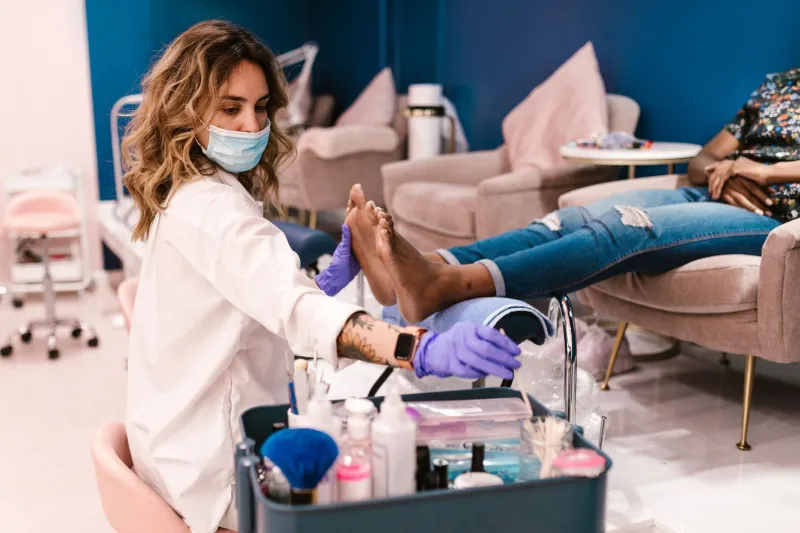
A proper pedicure — one that addresses calluses, nail health, and circulation through massage — doesn't just make your feet look better. It genuinely changes how they function, and that functional shift has a cascading effect on everything above them.
The Neuroscience of Feeling Put-Together
There's a concept in psychology called enclothed cognition — the idea that what we wear, and how we feel about our appearance, directly influences our cognitive performance and behavior. The research, pioneered by Hajo Adam and Adam Galinsky at Northwestern University, showed that people who wore a lab coat they were told belonged to a doctor performed significantly better on attention tasks than those who wore the same coat framed as a painter's smock.
The garment was identical. The meaning attached to it was not.
Now apply that logic to your feet. When you know your pedicure is immaculate — when you slide on a pair of open-toed heels and feel genuinely confident about every inch of what's showing — that knowledge doesn't just live in your head. It moves through your body. You stand differently. You gesture more openly. You take up space without apology.
Conversely, when your feet feel neglected, there's a subtle but real tendency to minimize. To keep your shoes on when others take theirs off. To cross your ankles under the conference table. To carry a low-grade self-consciousness that quietly drains cognitive bandwidth you could be using for more important things.
What High Performers Are Actually Saying
We talked to several professionals — a corporate attorney in Chicago, a financial advisor in New York, and a senior VP at a tech company in Austin — who all described their pedicure routine in terms that had nothing to do with aesthetics.
"I get a pedicure every two weeks, and I've started thinking of it the same way I think about sleep," said the attorney. "It's maintenance. It's recovery. My feet take a beating in heels five days a week, and if I don't stay on top of it, I feel it in my back and my energy by Thursday."
The financial advisor put it differently: "There's something about sitting in that chair for an hour that forces me to stop. I'm not answering emails. I'm not in a meeting. By the time I leave, I feel reset in a way that a lunch break never really gives me."
And the tech VP, who favors bold nail colors as what she calls her "secret weapon": "Nobody in a boardroom can see my toes. But I can. And knowing they look exactly the way I want them to look gives me this quiet confidence that I can't fully explain but I'm absolutely not willing to give up."
Posture, Stride, and the Physics of Presence
Let's get specific about the physical chain reaction.
When foot pain or discomfort is present — even at a low, barely-noticeable level — the body compensates. Weight shifts. Hips adjust. The spine accommodates. These compensations happen automatically, below the level of conscious awareness, but their effects are visible to everyone else in the room.
A 2019 study published in the Journal of Foot and Ankle Research found that foot pain significantly altered gait mechanics in ways that increased perceived physical vulnerability and reduced stride confidence. In other words, how your feet feel changes how you walk, and how you walk changes how you're perceived.
Regular pedicure maintenance — particularly the massage component, which improves circulation and reduces plantar tension — has been shown to meaningfully improve comfort levels throughout the day. Better comfort means fewer compensations. Fewer compensations mean a more natural, grounded stride. And a more grounded stride means you walk into every room looking like you belong there.
The Ritual Itself Is Part of the Point
Beyond the physical benefits, there's something worth naming about the ritual of foot care as a deliberate act of self-investment.
In a culture that rewards constant productivity and treats rest as laziness, choosing to spend an hour in a salon chair is actually a quiet act of rebellion. It says: I matter enough to maintain. My comfort is worth protecting. My presence in the world is worth preparing for.
That mindset — that your well-being is a professional asset, not a personal indulgence — is exactly the kind of thinking that separates people who merely show up from people who command attention when they do.
At Salon 3 Soles, we've always believed that luxury isn't just about what's on your feet. It's about how your feet make you feel in everything you do. The pedicure is where that belief starts — one step, one room, one confident stride at a time.